Monday, February 16, 2015

Tour de Palm Springs

I'm getting some down time in this weekend...and what else to do, other than ride a bike for a hundred miles while you're on vacation?

I road the century at the Tour de Palm Springs, and it was a great time.  The weather has been unseasonably hot, with highs reaching into the upper 80s--I know a lot of the United States is covered in blizzard conditions and entrenched in snow, so I feel very lucky to have this kind of weather for a long weekend getaway.

Elevation profile for Century Ride
The Palm Springs century has a great first half of the course.  The first 13 miles are a climb of about a thousand feet, which is just gradual enough at times that you don't really realize you're climbing that whole time.  There are definitely steeper and less steep sections for variety, but anything that seems flat is actually still a gradual uphill during that time.  It took me an hour and ten minutes to reach the top.  Following that, there's a screaming descent for about ten miles, and then some rolling hills before you reach another descent to the 51 mile mark.  That portion of the course is beautiful and scenic--taking you through windmill farms, and uninhabited back country on the North side of the freeway from the desert cities.

Century Route (101.5 miles)
The back half of the course leaves something to be desired.  It routes through neighborhoods of the cities of Indio, Palm Desert, Cathedral City, and eventually back into Palm Springs.  While there are times that it goes through some more scenic venues (like Palm Tree farms), there's a lot of traffic lights to deal with, and it's an open course, so a lot of traffic to deal with as well.  The combination resulted in a lot of time waiting at stop lights.  It also dealt me the hand of getting pummeled by this one peloton of riders taking off at every traffic light for about 20 miles, only to catch them and pass them before arriving at the next light.  This is the curse of the constant wattage mentality of the triathlete banging up against the surge-and-cruise mentality of the pack cyclist.

In order to fall in line with a pack, you'd generally have to hammer in 300-400 watts to accelerate with them from a stop, and then draft off the back of them, and drop down to something small, like 120 watts.  While that kind of riding has its place, it's not the way that training goes down for someone working on their ability to sustain an effort for an Ironman or Half Ironman distance race. Since drafting is not legal in the sport of triathlon (aside from the format reserved for the elite few that race at the ITU level), your ability to race well depends on your ability to average higher wattage over the course of many hours, and generally speaking, each of those bursts of power takes away from that capability for a given ride or race.  It also makes it much harder to have a good run if you've spent your time hammering in massive spikes in power over the course of 56 or 112 miles.

Blue skies for a relaxing day at the hotel pool
I'm extraordinarily happy with the way this ride went--after my surprise half marathon PR last weekend, I spent several days extraordinarily sore, and my knee was irritated and tight.  My running this past week suffered--an easy 3 mile run one day, 4 miles another day, and I still had knee pain going on.  I biked easy until Thursday, when I was able to put some decent intervals on the bike.  Approaching this century ride, I asked my coach if she thought I was in a position to make it through this ride, and I had already figured an escape route if I started having issues early on in the ride.  We decided to let it be my call on the morning of the ride.  At about mile 30 of the century, there's a merge back into the 55 mile course that would create about a 68 mile ride instead of the 101.5 miles for the full century.  I got to that point and felt good.  There's also a way to cut about 20 miles off the course later on, and I got to that point and felt that was unnecessary.

I completed the century ride in about 6 hours and 40 minutes (stopping time included).  My actually moving time was 5 hours and 50 minutes.  (Lot of stop lights and a couple of SAG stops to refuel and re-sunscreen).  More importantly, my normalized power was 2 watts higher than my best ironman bike split--156 watts, so it was a complete shock to me!  Even without the difficulty recovering from my run last week, I wasn't sure how well trained I was for a long duration bike ride, since my off season rides have been in the range of about 3 hours up to this point.  It all worked out really well!

And now I'm off to enjoy my last morning of lounging by the pool before heading back to the real world.

Monday, February 9, 2015

Nana korobi ya oki / San Dieguito Race Report

So you've all seen my Facebook page in the last couple of months and know that I got a tattoo, and probably know what it means...but I haven't really written about it yet.

IMAZ, 2008.  I look like I'm going to puke.
About 15 years ago, I decided I wanted to do an Ironman triathlon, and I set about doing what I thought I needed to do in order to get there.  Like the fool that I was, I thought the hardest part would be the run, because I was a swimmer--and what could possibly be hard about riding a bike? Years of grueling workouts would eventually teach me exactly what could be hard about the bike.

I started with training for my first marathon--it would be the LA marathon of the year 2000.  And then I quit my job, and moved to Austin, TX, and decided I would run the Austin marathon that same year instead.  And that's when I injured my foot, in what I would be told by a doctor was this weird thing called "Plantar Fasciitis."  To fast forward through the whole mess, I gave running and triathlon a go for a while, and successfully ran some half marathons, did a couple of olympic distance triathlons, and some sprints, but I never conquered my problems with my foot pain.  I eventually stopped doing them completely, and just focused on swimming...and even that fell to the wayside at times.   It turned out that I was in this really awful relationship (thankfully, gay marriage was not legal at the time), and I lost myself...I lost myself a lot. 

But I eventually found my way back--and had a lot of help along the way.  Elaine Ryan may not know the impact that Brian watching her finish the Long Beach marathon had on me that year--he came home that day, and talked about how he wanted to run a marathon, and I decided I was going to call his bluff.  I laid out the training plan based on the same calendar I'd used leading up to LA/Austin of 2000, and it turned out that we needed to start in a week and a half.  And Brian was like "Yeah--let's do that!"  And I was thinking "I'll go along with this, and he'll give up...and we'll get to eat a lot of pizza along the way."

First sitting for tattoo
It turned out I actually made it to the start line of that marathon, and finished it.  I walked a lot in the last 10 miles, and Brian beat me by something like an hour--I could go look at the exact times, because we framed our finisher's certificates as our first marathon.  I would go on to complete Half Vineman, Ironman Arizona in April of '08 (the last year they had it in April)--it was hell on Earth. I would eventually complete 3 Ironmans, numerous half irons, and who knows how many runs, bike rides, and shorter distance triathlons along the way.

I would also go on to fight injury--and with the help of my coach, I would learn how to deal with it correctly. Being an endurance athlete means figuring out how to deal with your deficiencies, and if you don't figure out how to deal with them, they become injuries, if they weren't already injuries to begin with. Over the past 2 years, I've dealt with a significant recurrence of my plantar fasciitis and also some excruciating lower back pain that I refuse to go get imaged to "see if there's a disc problem."  I watched Brian have his spine fused and decided that my pain was not significant enough to consider that as an option, even if I have a mechanical defect of my spine.  I'm not in denial--my chiropractor thinks it probably isn't a disc issue, but may be an irritation of the facet joint, and thinks that my dominant problem is all about muscular tension, imbalance, and weakness.

Finished tattoo
The last 6 months have been about approaching these issues from a different place--I'm getting massages every other week, seeing a chiropractor once a month, and doing strength exercises to build up the core weaknesses that I have.  And I have been running more consistently and faster than I ever have before.

Earlier last year, Joanna asked all of her athletes to come up with a mantra--whether we kept it to ourselves or not--something that you could draw motivation from.  I defaulted back to something I used to say to myself as a swimmer, which was Muhammed Ali's "Float like a butterfly, sting like a bee."  I didn't realize it at the time, but my mantra is actually what I had tattooed onto my torso during the off-season this year.  The Japansese proverb "Nana korobi ya oki" means "Fall down seven times, stand up eight," or to put it simply, to never give up. 

But it's more than that--it's about figuring out what not giving up actually means--it is not a blind step forward every time you get knocked off of your original heading.  It's about finding your path in life in the face of all of the obstacles that are thrown at you. And special thanks to Robbi Miller, for telling me how to pronounce the phrase--I feel like I probably should have figured that out before I had it permanently inked on me!

Yesterday, I ran the San Dieguito half marathon, and I would have been happy with my result even if I had to walk the last few miles into the finish--it was the first half marathon I've run in over three years due to injury.  I would have been ecstatic to be able to run the whole thing, and when I came to understand just how hard the course was (at about mile 3, in the middle of the race), I realized that doing anything close to my old PR on this course would be an outstanding success.  My old PR was
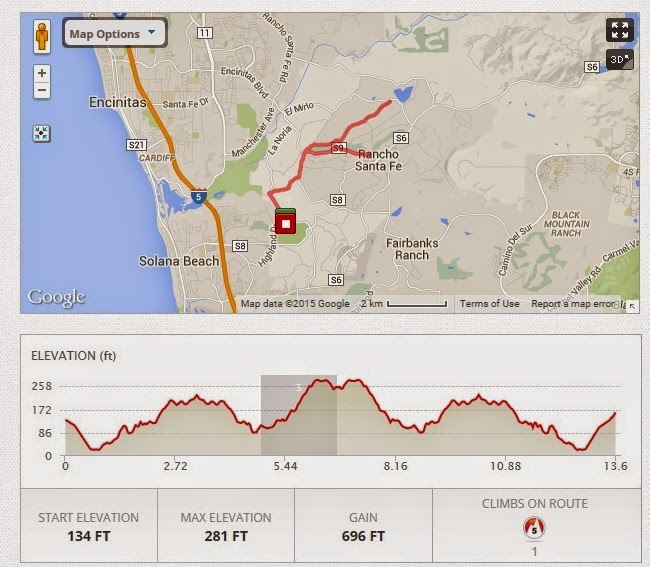
Hill profile for San Dieguito 1/2 marathon
1:53:50, which was done on the Long Beach Half Marathon course...one of the defining courses for the word "flat," with a bridge or two.  Yesterday, I ran 1:50:37 on what "is arguably one of the hardest half marathons around," to steal the description from Joanna. If Joanna says it's a hard course...it's a really damn hard course!

I think the more important thing is that I'm really enjoying what I'm doing again, and that's what really matters. So get out there--seize the day--get knocked down, and find your way to get up again!


Sunday, February 1, 2015

Don't be a statistic!

Yesterday, I was perusing articles online, and one grabbed my attention--the subject was that athletes are not immune to hypertension. Without repeating all of the details, the net conclusion was that studies on athletes involving the risk of high blood pressure have been poorly done, and not well documented, but that statistically, it appears that athletes have the possibility of developing unhealthy blood pressure independent of their activity level.  The conclusion makes sense--if you work out all the time, it does not give you carte blanche to eat nothing but fried food and desserts while smoking and drinking a fifth of vodka every day.

What concerned me was some of the comments to this article--and one in particular from a guy who was obviously a medical doctor of some sort.  He stressed that his recommendation was for everyone to take in no more than 2300 mg of sodium per day.

About a decade ago, I was diagnosed with a heart condition, called a patent foramen ovale with atrial septal aneurysm (PFO w/ASA), and was simultaneously misdiagnosed with hypertension. The PFO w/ASA is a topic for another post--but right now, I think it's important to point out the missteps that the medical community made in relation to my misdiagnosis.

First and foremost, blood pressure readings were taken on me that indicated that I had borderline high blood pressure, measuring anywhere from 130/85 to 150/95.  These numbers, standing without context, are enough for pretty much anyone to suspect that there is a problem. But context is something that appears to have lost traction in today's slam-bam-thank-you-mam 5 minute visit with a medical professional.  I was placed on blood pressure medication, and my numbers came down...way down.  Frankly, I think that I could barely move.  I lost the ability to exercise effectively--running become next to impossible, and I wound up having to move down a couple of lanes at masters swimming.  It was my own conclusion that a drug that prevented me from working on things to improve cardiovascular fitness was probably not the right answer, and I stopped taking the blood pressure medication. I did, however, heed the advice of the doctors to watch out for "excessive sodium intake" and began watching my diet for these things while training for and (barely) completing my first marathon.

In the years that would follow, I would successfully complete two ironman triathlons, along with a number of other things, take off a minor amount of weight, and have wildly fluctuating blood pressure readings.  All the while, I would watch for dietary consumption of sodium, but know that to complete an ironman triathlon, supplementing electrolyte intake was important.  People collapse on the course due to sodium depletion routinely--so routinely that seeing someone hooked up to an IV in a medical tent is an expected part of the race.

I developed wicked headaches after most of my long distance training sessions.  Common knowledge was that I must have been dehydrated, and I would talk to people (other athletes, my GP, one of the several cardiologists I saw, and a nephrologist) about this, and explain that my urine was clear, and a universally puzzled look would come across their faces and the conversation would end. It was not until I started working with my current triathlon coach (Joanna Zeiger) that we got to the bottom of this.

I raced a half marathon one day, and did not do as well as I would have liked. My muscles seized on the finish line and I couldn't move for a period of several minutes. This passed--and I went home and somewhere during this process texted Joanna my result, the fact of my headache, and that I seized up on the finish line, and that I was in no condition to talk to her.  She was persistent (not out of the norm for Joanna), and eventually got through to me that she thought that I was low in sodium.  She had no idea at the time what I had been through regarding the whole mess with my heart condition and the recommendations from doctors to limit my sodium intake. In desperation, I conceded to try consuming what would wind up being three cans of V-8, with a little water to wash it down (that's right--36 ounces of the stuff, containing nearly 3 grams of sodium). The effect was rapid--over the course of a couple of hours my headache would disappear, my mood would improve, and I would feel like the adverse affects of the half marathon never occurred in the first place. In the past, once a post workout headache would occur, it would stick with me for the rest of the day, and only relent with the passage of time, generally until the next day.  So, this change was dramatic.

The fact of the matter is that physicians are trained to act based on statistics--the vast majority of patients that they see with a high blood pressure reading are sedentary and they do not exercise at all, let alone to the point that triathletes do.  The recommendation of no more than 2300 mg of sodium per day holds true for a very large percentage of the population, so they're going to be right probably 99% of the time.  The problem is that endurance athletes are the statistical anomaly in their day to day operations.

  • Endurance athletes sweat (a lot).  It's not uncommon for me to lose, and subsequently replace, 5 pounds of water weight a day while training.  Each pound of sweat lost contains, on average 1.5 grams of sodium.  Simple math reveals that 7.5 grams of sodium lost is much more than the 2.3 grams of dietary sodium recommended as a maximum.
  • Athletes tend to have more muscular arms.  It turns out that most nurses, and some doctors, are unaware how much the wrong size blood pressure cuff can affect a blood pressure reading.  Switching to the "fat-people cuff" revealed that my blood pressure is within the norm for the population.  Too small of a cuff crushes the blood vessels in the arm, creating a situation where an accurate reading is impossible.
  • Athletes tend to get workouts in all the time...and those workouts can cause increases in blood pressure that last for hours, often spiking that blood pressure reading during your office visit.
  • Some doctors have a problem with a god complex.  One cardiologist I saw would not even let me finish a question about how much I sweat and how to deal with that while limiting sodium intake.  In retrospect, it would have been best if I had never gone back to see this guy again.
  • Low blood sodium is much more dangerous than high blood sodium is, with risks including hyponatremia, brain swelling, loss of muscle coordination, and potentially the risk of fatal fluid buildup in the pericardium.  It is possible that the heart palpitations I have experienced in the past are the result of insufficient sodium in my bloodstream.
  • A lot of pills sold as electrolyte supplements do not contain enough sodium to be effective.  Before my collapse at that half marathon, I was using Endurolytes (80 mg of sodium per pill) and not taking enough of them.  Since then, I have switched to SaltStick (215 mg of sodium per pill) and now take 4 per hour while running (or more if very hot).
The simple fact of the matter is that today's medical industry does not adequately address the needs of the athlete, and it does so for very good reason.  The endurance athlete is the 1% of the clients that they see, and they're going to be right much more often by ignoring them.  I have to remind my doctor during my annual physical to use the large blood pressure cuff, that I worked out a couple of hours beforehand, and that in the past week I've sweat out approximately 15 liters of fluid. Nobody is going to fix this problem with modern medicine, but with the right knowledge at your disposal, you can probably avoid becoming a victim of it.

Saturday, October 18, 2014

The stages of a triathlon

Last Sunday, I was smacked in the face with how far I have come in the sport of triathlon.  To summarize the race, I was 3rd out of the water, fell back to 10th place during the bike, and then had my knee seize up on me during the run and had to walk the last 3 miles into the finish line.   The swim and bike are likely my best performances ever in a triathlon, and gave me the opportunity to hang with the upper echelon of that day's race competition--it was enthralling!  A few years back, I could have never hoped to be in this position.   And my run falling apart was much more about the fact that I've had difficult times at work and haven't been able to get in the training required to go the distance with those guys.  I'm not concerned about it at all.

Though, what did happen was that I had a chance to witness all the different varieties of attitudes that are present at a race.

1.  The race leaders:  the guy I was running with initially showed concern that I dropped off the pace and gave me a simple "Come on, you got this..." and then remained steadfastly focused on his own performance.  The other people who passed me could not care less--I was just one less person to threaten their spots on the podium.

2.  The concerned crowd:  The people passing me quickly morphed into a group that was concerned for my well being--"Are you ok?" (with the implication being "medically").  I assured them I was--just having issues with my IT band, and everyone kept running on their merry way.

3.  The motivators:  Somewhere, the middle of the pack transitions to this group of people that are super-motivators.  Every single person, for what seemed an eternity, was determined to get me running again--by this point, I knew my knee would not function again for that day, and I was doomed to a long walk into the finish line.  This peaked with a guy coming up from behind me, grabbing my left arm, and screaming "You can do it--You've only got 2 miles to go!!!"  I nearly crapped my pants from the shock.

4.  The experienced finishers:  After the supermotivators, I encountered several people that offered words of encouragement, but clearly had seen my situation before.  They knew that I knew that they knew that whatever they said was appreciated but wasn't going to do a damn bit of a good.   I know this from the telepathic bond formed that was predominantly "Not your day today?"

5.  The walking/jogging/running dead:  There's a group at the end of a triathlon that is simply trying
to survive to the finish line--and while they're completely motivated and concerned about you, they don't have the energy to outwardly offer encouragement.  None of them appeared to be at the point of needing to eat flesh straight off the bone yet, though.  So I got to save that visual for the Walking Dead premiere later that night.

Looking forward to next season--for now, my focus is on a the SPMS Champs swim meet in December!

Sunday, September 28, 2014

The lone cyclist

Something I came to terms with a few years ago was making a decision between training and riding, and when it comes down to it, it's a decision I've continued to have to make on a very frequent basis.  When I started working with my coach, Joanna Zeiger (racereadycoaching.com), the way I approached cycling workouts didn't just change--it was upended, torn apart, and put back together again all over the course of that first year that she coached me.  I got a power meter, and I struggled with it.  At first, I struggled to even grasp what I was supposed to be accomplishing with the numbers that seemed to be only tangentially related to what I thought was going on with me on the bike.

Joanna was very patient with me, and took me through several of my power files over time, and explained what the issues were.  In retrospect, it really wasn't surprising.  Cycling, in general, does not lend itself to encourage you to do what you should actually do to get better.  When you ride in a group, you really have no control of what kind of effort level you're putting into the pedals, and more than likely, you wind up riding too hard on uphills, and way too easy when sitting in the draft zone of even a single cyclist.  Your workout tends to look like a mess of random garbage that doesn't really train your muscles or the energy systems that supply them in order to make you go faster. Over the course of years, I've discovered that most cyclists tend to double, if not triple, their power output when going up a small hill.  As an example--you're pedaling along at something close to your long distance aerobic pace--let's say 150 watts, and when you reach a hill, you feel the need to maintain your speed, and testosterone kicks in, because who wants to be the one to slow up the pack going up a hill?  It's not uncommon for me to sit in the back of the pack when this occurs and watch how I have to break 300 watts and approach 400 watts or even more just to stay on someone's wheel. So, you've gone from something you can probably maintain for 5 or 6 hours, to something you wouldn't be able to maintain for 5 or 6 minutes, all based on the randomness of the road.  There simply isn't another sport that this happens in.

An example of a pretty decent power file, with a 20 minute long interval in the middle of it

I don't crank through workouts that way anymore--if I ride with a group, which is rare, I tend to hang in the back, and drop off the pack going up a hill.  I'll catch them on the downhill or a flat that follows.  When I do ride with a group, it's usually for a workout that I'm not trying to accomplish something specific, or it's for a portion of the workout that my effort level can change--the warm-up is usually an ok place/time for me to do that.  The simple fact of the matter is that I watched myself take an hour and a half off of my ironman bike split when I trained correctly, and that's what I was after all along.  I've found that most people in triathlon don't actually want to ride like that--they're there for the group ride--and to have fun, which is perfectly ok.  I just decided a long time ago that triathlon was about setting and achieving goals for me, and doing what I need to do to make that happen.  So I wind up riding alone--a lot.  Occasionally, someone rides with me, and does one of my workouts with me, but it never seems to stick--while I can guess as to the reasons why, I don't actually know in a lot of cases, because we're all out there for a different reason.

So, it's time for me to get out of my head and get on my bike, for a long ride with some long intervals at half-iron pace.  Ride on and be safe everyone!


Sunday, September 14, 2014

"Hi, my name's Drew and I'm a recovering swimmer from the '90s"

I grew up in the age of "You will swim 17,000 meters a day, and if you don't get good from it, that's your problem."  This has left a lasting impression on my life that is flawed to its very core. On one hand, the work ethic that swimming taught me was unparalleled to anything I probably could have gotten as a child, and that's saying a lot, given that I grew up in a military household where sitting around and relaxing was viewed as a cardinal sin.  On the other hand, it mistakenly taught me that more is always better, and it has taken me decades to unlearn, and something that I still struggle with on a daily basis.

I was lucky going through school because it was easy for me--people used to get really pissed at me when I explained to them that the amount of time I spent studying for exams was on the order of minutes, as opposed to hours or days in some cases.  It was simply very straightforward for me to identify what I didn't know, review that, and be done with it. My test scores, grades, and acheivements all reflected that, and I carried this into my professional life.  The only difference was that time became measured in hours worked, rather than in tasks accomplished, and I set out at a very early time in my career to fill my days with the most productive time I could, rarely exceeding a 40 hour workweek and often outperforming my peers in the process of doing so.  I'm only saying this to point out that somehow I was lucky in not letting the lessons that were ingrained in me as a swimmer carry through to my career.

I am, however, extraordinarily hard on myself in my activities outside of work.  Joanna, my triathlon coach, has pointed this out to me, and she has been dead on.  If I am not exceeding the bounds of reality of what my body can handle, I am not happy with the results of my workouts.  If I am not constantly achieving new PRs, I am not satisfied with my race results.  If I'm not doing all of this while I'm holding down a job as an aerospace engineer, where I am routinely faced with the realities of a contracting industry laying off workers left and right, then I have failed.

I think that the lesson that I had to learn, and still have more to learn about, is that sometimes non-perfection is good enough.  Beating myself up for ending my workout yesterday after a wasp sting is not productive, and given the black-and-blue mark I have on it today, I probably didn't need to finish my hard intervals while riding home.

I'm not going to the Olympics, and given that I'm about 3 hours out of contention for a Kona slot, I'm not going there either.  The daily struggles that I have with performance have to be more about enjoying the process, rather than focusing on the result, and I think I've lost touch with a lot of that--so I was all too happy this morning when a brief bout of runner's high kicked in during my 10 miler, and I could remember what it's all about.

It's time to just enjoy the day.