Tuesday, December 31, 2013

Thoughts on my last run in DC this year


While I was on the east coast for the past month, I noticed there's a spot on one of my usual running routes that I briefly pass into the District of Columbia and back out again, within the course of a couple of hundred yards. Since I have plenty of time to ponder things while running, I started thinking about how arbitrary this line seemed to me, but then also how weird it was. From a geographical standpoint, the division made no sense to me--it's on the west side of the Potomac, and should fall, very clearly I thought, onto Virginia's soil. From a social and legal standpoint, I thought about how my marriage to my husband was valid and recognized for a couple of hundred yards, and then how it stood in the weird legal status countless gay couples' marriages stand in when they reside or visit states like Virginia. After this year's Supreme Court action, the nation appears to have taken on a direction of gay marriage being valid federally, almost without regard to a person's place of residence, but invalid on a state level in states that don't recognize it. I wondered--if I had a heart attack while running and collapsed on one of these lines, what would happen with regards to Brian's hospital rights? I ultimately decided that it depended on what hospital I got taken to, and then decided it didn't matter since we have medical powers of attorney on each other specifically to deal with situations like this. I would, however, be willing to bet that an increasing number of gay couples in states where gay marriage is legal have not taken this extra step though.

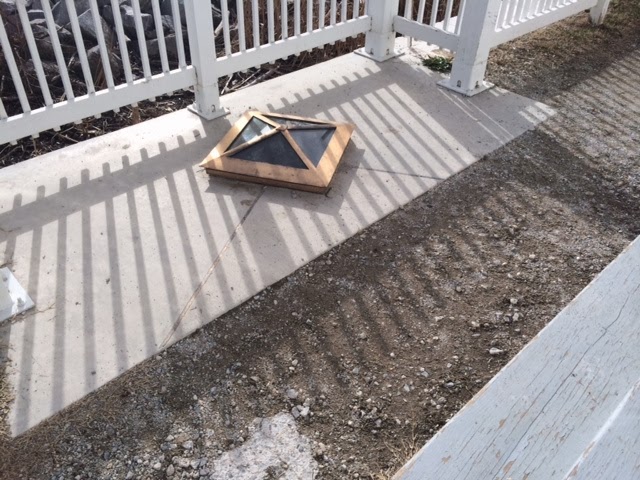
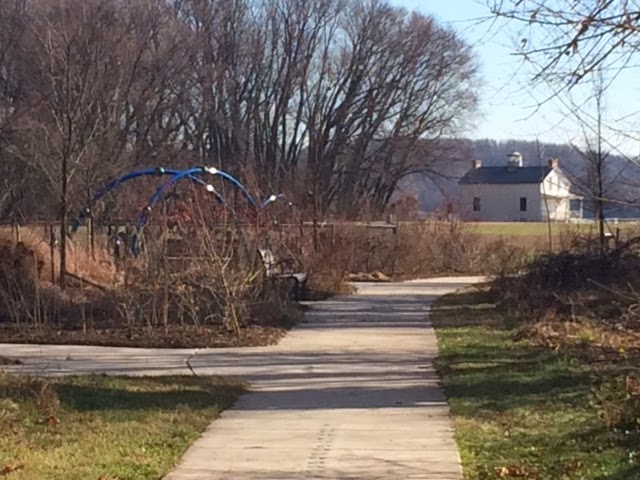
On my final run while I was in DC, I decided to stop and take some time to explore this weird area, and found out very quickly that it is a place called "Jones Point Park." A concrete marker just south of the lighthouse at Jones Point sets the very southern tip of the DC area, and some history explains that this occurred when Maryland ceded its land to create the District of Columbia. This photo shows the lines of demarcation between Virginia (right side of photo), D.C. (area in the center), and Maryland (left side of the photo). 


Once again, this all seemed really arbitrary to me, until I read some more on the signs posted about the park--it appears that Jones Point was an original harbor used by ships that docked for shipments that were transported along Telegraph road in Virginia and that these shipments were largely composed from the tobacco trade of the time. If I learned anything in the upper division American history class I took during college called "The Coming of Civil War," it was that the economics of the tobacco trade were one of the most significant factors that divided the north from the south during this horrendous time of American history. We're all taught as children that slavery was the divisive issue among the states, but the reality is that slavery was brought into the south largely by the motivating factors of the southern plantations, and it was what made it seem okay for people who owned slaves to own them. It was what allowed one man to own another, and treat him like property instead of a person.

So as I was standing there, taking a break from my run, I realized how petty all of this actually is--I was standing in a spot half in and half out of an area that recognized my marriage and thinking about how important that was, while in the not so distant past, it signified where and when it was acceptable for one man to beat and torture another, and use him until he was dead for something no more significant than the color of his skin.

I would like to think that our society has evolved past a point of racism, and past a point where little differences between people's heritages make a difference, but the reality is that we haven't. Black Americans have had full legal rights for many years now, but are still discriminated against on a daily basis. People are singled out on the basis of their ethnicity, their religion, their sexual orientation, and a huge list of differences that really don't matter because we are all people. It's time we got over this--we are bound to repeat the mistakes of our past, not because we didn't learn our history, but because we didn't understand what it meant.

So I finished my run, and then I got home from my business trip a couple of days later and told my husband that I love him. I think that's the most important thing we can all do.


Sunday, October 27, 2013

The Spine-athalon


“We need to say ‘I love you’ more,” was what my husband told me as he lay in the recovery room immediately after having his L5 and S1 vertebrae fused.  Or rather, immediately after having his disc in between his L5 and S1 vertebrae removed and an artificial cage with scaffolding put in place instead.  Spinal fusion is not something that happens during surgery, but something that occurs during the long, arduous months that follow surgery, as your body heals as a result of the actions taken by a surgeon.  In the meantime, you spend a lot of time lying around, being mostly incapacitated and waiting and hoping for the spine to fuse.   Brian has taken to watching a lot of movies.  

But the beginning of post surgery is something that took me aback—right from the very few seconds that I saw him.   I was lucky enough to be allowed in the post surgery recovery area, and they let me in to see him as early as they allow anyone—and immediately when I saw him, I could tell the effects of anesthesia were still with him, and the effects from the morphine they were giving him added to it.  Brian babbled—he talked about some of the most ridiculous things….’I need to buy new sheets’…’I want to organize that shelf in my room’…’I’m in pain…it’s a four’ (I had to tell his nurse to double any estimate of pain he was giving her)…and the one that really stuck with me: ‘We need to say ‘I love you’ more”…and we do. And that’s mostly because everybody does—but more because, as men, we tend to have a gender-biased assumption that “If I told you I love you once, and I haven’t told you otherwise, then it hasn’t changed.”  Ugh…me…caveman.

I spent a long time debating about whether to tell him about this, because I’m very certain that he doesn’t remember anything from that time in the recovery room—I didn’t figure this out until a day later when I was telling about our friend Jeremy and asking if he’d talked to him since those text messages in the recovery room.  He had absolutely no recollection of the subject.

The time that follows a spinal fusion is nothing short of a roller-coaster ride.  Brian spent the first couple of weeks talking in his sleep—I’m not capable of telling you what he said, because it was completely incomprehensible, aside from a couple of “What the fuck?” statements.  He had episodes of horrible stabbing pain…he had constant less intense pain.   He spent 5 days figuring out how to get his lower GI tract back to normal, and it turns out prune juice was his savior.   Doctors tend to like to prescribe things—colace and milk of magnesia didn’t do shit for him.  (Pun very much intended)

His care has taken a lot of my time as well—in the first couple of weeks, he was barely capable of moving around the house, so every meal, every drink, and some nurse-maid duties such as the male porta-urinal were all des rigueur.  I had to leave for work for about two and a half weeks after that, and he somehow managed to survive.  I’d made frozen meals for him from Dream Dinners and we worked out that he was able to place them in our above stove combo microwave/convection oven.  We set everything we could at waist level or above—he is still not allowed to bend down to pick anything up for any reason.   I owe a huge debt of gratitude to all of our friends that came by during that time—you all saved him.

We saw a glimmer of the road ahead the other night by going to our friends’ Steve and Colvin’s wedding.  Some fun times at a point about 8.5 weeks after surgery—Brian had to alternate between sitting for a while and standing for a while the whole time we were there, and he loved being at dinner (and congrats again Colvin and Steve!)  Riding in a car is still a very limited activity though.

I’m particularly worried about how the next couple of months go because everybody refers to it as the danger-zone in this healing process.  People tend to feel better and push too hard.  Brian’s exhibiting some symptoms of wanting to do that, but so far, he’s kept his head on straight.   He’s allowed to walk in the shallow end of the pool for 20 minutes a few times a week, but otherwise, his only other exercise is his 1 or 2 twenty-minute walks around our neighborhood each day.  There’s still no bending, no picking up Max’s pills off the floor if he drops them—no actual swimming, and no significant riding in a car. 

I’m currently sitting on a plane for another work trip, trying not to feel guilty about the two workouts I missed yesterday while I was putting the house in order for him to be alone again.  My return to triathlon training hasn’t so much been affected by this as it’s just been a little slow—occasionally, there is just too much to do in a day, and that’s ok.  It’s entirely possible that this slow readjustment to training has been what’s keeping me from reinjuring myself—life can work that way sometimes.

I’ll just wrap this up by taking a little bit of his advice—I love you, Brian.  Keep taking care of yourself and take it easy.

Sunday, July 7, 2013

51 Weeks

51 weeks ago today, I finished the Vineman 70.3 triathlon, limping my way through 13.1 miles of running--the rest of the race went pretty well, but the run was the nail in the coffin that I had to do something different to fix my foot. And I did--which finally resulted in my return to running yesterday, with my first race since that date last July. I completed a 5k, and did so without redestroying, reinjuring, or otherwise seriously exacerbating my foot again.

While 51 weeks seems like an awfully long time, it's really not when put in perspective with the last time this happened to my foot, back in 2000--that round of plantar fasciitis resulted in me quitting running and triathlon, and not returning to either of them until 2006. So, 51 weeks is a lot better than 6 years.

The biggest difference though, isn't the amount of time, but how I've recovered from it--that 6 year recovery was me simply staying out of running, and my feet healed over time. The root cause however, was clearly still present since I wound up reinjuring myself at a later date. This go around, I maintained fitness, primarily on the bike, and had a number of false starts with running. Therapeutic interventions included everything under the sun--most of which I'm still doing now to keep my foot on the path to success. Egoscue therapy (www.egoscue.com), TP therapy for Plantar Fasciitis (http://www.tptherapy.com/Shop-Online/All-TPPT-Products/Foot-Lower-Leg-Kit.html, if you're looking for it), massage therapy, acupuncture, and the Graston method were all tools that I employed to various degrees of success.

I have to say though, that without a doubt, the single most important thing that made the difference this time was the advice of my coach, Joanna--she kept me sane, and talked me off the ledge of quitting a number of times over the past year. I am sure there were times that she thought I was such a mental case that I was beyond saving, so I definitely owe her a big thank you! So, thank you, Joanna!  Looking forward to you kicking my ass as my foot continues to improve.

I've still got a long way to go--I'm very certain that if I were to stop the therapies I've got in place now, I would immediately hurt myself again, but I feel like I'm over the hump. Stretching, strengthening, and foot mechanics are all things that will require constant vigilance from me.

If you've stumbled upon this page looking for a magic bullet for the cure for plantar fasciitis (as I was hoping to find many times when I scoured the web), I can't tell you that I have it. I think that everyone's case is different--for me, it was probably the sum of a number of things. This last few months, I've spent time essentially relearning to run, by bumping up my cadence to above 90, which resulted in changing my foot strike. Acupuncture and the Graston method left me horribly bruised many times, but helped to break up and heal what was likely years of scar tissue. TP therapy helped to keep my calves healthy and various exercises from the Egoscue method have helped me to activate strength in the major muscle groups of my lower body.

So, I'm glad to be back at it, and looking forward to my first triathlon in quite a while. Just keep running!

Sunday, May 19, 2013

Bike Maintenance--The doctor will see you sometime next week...

Yesterday, as I sat staring into the bucket of bio-solvent degreaser and black bike grease I'd just created, I started wondering if there are people who are skilled in prognostication using shapes that appear in the sludge buckets from bike maintenance. Unfortunately, I failed to take a picture, but I didn't really see anything there anyway.

Bike maintenance is one of my personal pet peeves about doing triathlon. I find it incredibly difficult to lug my bike to a bike shop and have them do it for me, but the reason behind my annoyance probably isn't what you would think--I would gladly pay somebody to do this mess of stuff for me--mainly because I have no formal training in bike maintenance and have learned what I know so far from watching You-Tube and reading bike maintenance books. My problem with the whole thing is how getting maintenance done on your bike has evolved in Southern California.

The process, as it goes, is something like:  1.  Bring your bike into a shop  2.  Leave it for some seemingly excessive period of time.   3.  Pick your bike up and pay for the service you had done  4.  Get your bike home and see if it actually fixed the problem you had.   5.  Repeat until desired fix is achieved.

You might gather from those steps that I am less than happy with the experiences I have had with anyone who's done maintenance on my bike, and you might be right. There's one shop in Long Beach I won't even bother to walk into anymore. Aside from the problems I've had with them from a maintenance perspective, they generally only have what I need for parts about 25% of the time. How a bike shop repeatedly runs out of tubes baffles my mind. It's a little bit like mexican restaurants that run out of tortillas.

So, I was buying some energy drink powder yesterday at Tri-Zone, and I asked them what their current turnaround time on bike service is, and was told that it's about a week--which is pretty good for this area. I've had to sacrifice my ability to ride for 2 weeks at times in the past in order to get service done. I told the guy thanks, and decided I would give my creaking once-per-pedal revolution issue one more shot in my home shop before committing to taking into a shop. I'm glad I did.

For the past month or so, I've had pedal creak--and google led me down a number of different paths as to what the issue might have been. I overhauled my bottom bracket--pedal creak continued. I made sure the crank arms were torqued to the proper value (I think like 12 Nm--I can't remember, it's printed on the crank arm), and the creak just kept going. I talked myself into the possibility that it might be my saddle, even though the creak continued at times when I was out of the saddle. I cleaned and lubed my chain. I lubed my pedals and my cleats. I inspected my cranks for play in the bottom bracket. All the while, the creak continued.

One of the bike maintenance books I have suggested that creaking may be the result of not enough lubrication between the freehub and the cassette, so I decided to take a look there. I attached the chain whip to my cassette, and as I went to remove the lock ring, I realized it spun freely--to the point that I didn't actually need a wrench to remove the ring and probably could have spun it out entirely without using a spline tool. I immediately realized that this meant that my cassette wasn't tightened down and could very easily have been the source of my pedal creak. Google had failed me--not once when searching for what may cause creaking did the cassette come up as a possibility.

I cleaned all the crud off my cassette after breaking it down into individual sprockets and spacers and put it all together again. Today was a creak-free ride.

I don't mind doing my own bike maintenance--I actually enjoy it because I am, as it so happens, an engineer by profession and this is probably the one hands-on mechanical thing I do in my life. I just don't always have the time, or the requisite knowledge. I kind of wish somebody would come up with a better system than "Let us hold on to your bike for a week or two and do nothing to it until we can spend an hour servicing it." Simply put, the people who do bike maintenance well deserve every penny they get.

Sunday, April 21, 2013

I am an addict.

It will come as no surprise to people who know me when I say that I am completely, horribly, and happily addicted to caffeine. My relationship with the substance began my freshman year in college, and never let go--like so many people in the world, it's what gets me going in the morning, boosts my mood, and makes me a more productive person. The consumption form of choice for me is coffee and espresso, both black. Sugar and milk mar the taste of perfection for me.

I'm not here today to debate the pros and cons of caffeine consumption--let's just say that if I did, I would weigh heavily on the pro side, and have a very difficult time coming up with an unbiased argument. I'm here to simply state that I've had a long history of overdoing it, and a little moderation is required.

I've laughed in my doctor's face when he has suggested getting off of it entirely--armed with some simple facts, he's let it go after I quickly retorted. There's only a casual association of caffeine consumption with high blood pressure, and the medical literature basically states that increased blood pressure is a transient response present in caffeine-naive individuals--simply put, if you're going to drink it, drink it all the time and drink it consistently. My issues with depression kick into high gear during caffeine withdrawal periods. He backed off immediately after hearing that.

My kick-ass espresso machine
My problem is that it's been too much, and not well timed through the day. In the height of my most recent peak with it, I was putting down 12 shots of espresso a day--somewhere between 900 and 1200 milligrams of caffeine, which far exceeds the maximum recommendation of 300-500 milligrams of consumption per day. Even I could not argue with the idea that this was probably contributing to my issues with anxiety, inability to sleep, and generalized grouchiness. In my defense, I had just bought a new espresso machine, and the stuff was delicious.

So, about a year ago, I tapered it down to 6 shots a day, and things got better. Still consuming between 450 and 600 mg of caffeine a day until about a week ago, I continued to have some issues with sleeping, though not nearly as severe as I've had in the past. My most recent look at this was brought about by some of my friends buying me a pound of something called "Death Wish Coffee," which is a brand of coffee made entirely from the Robusta variety of coffee beans, and those beans contain about twice as much caffeine as the more typical Arabica beans. I tried it out one morning, and had two cups of this coffee instead of my usual four shots of espresso--the result was that I did not sleep at all that night.

Tassimo--Creator of the "weak" coffee I drink in the afternoon
My heightened detective skills were put into play to come to the conclusion that my two cups of Death Wish coffee had not been metabolized by my body over the course of 16 hours, and I drew the conclusion that my issues with getting to sleep in general were probably due to having too much caffeine in my system when trying to get to bed.

I've now been one week with dropping down from 6 shots to 5 shots of espresso a day (or sometimes 4 shots of espresso in the morning, and an equivalent "weak" cup of coffee in the afternoon). Sleeping seems to be going better, but the real results won't be in for a while, after I've gotten through the adjustment period and I've seen what the long term effects of the change are.

Saturday, April 13, 2013

This is where they took the not-cancer out...

About a month ago, I went in for a routine mole check with my dermatologist--I'd made it a habit to go in for the screenings every 6 months about 10 years ago. The first time I saw him, he found something suspicious, and scalpel biopsied it. It came back as moderately atypical, and had to be further removed with what I'll call a punch removal system--they have this device that carves out around the mole. Then, they lift it up and slice it from underneath, leaving something that looks like a paper punch in your skin. They stitch this up and send you on your way. That time, the removal came back as clear in the margins, and I was done.

Since that time 10 years ago, he's decided to take off one other mole that wound up being suspicious, but he got that all completely off with the first scalpel biopsy. Aside from that, it's been a couple of false starts initiated by me--things like a mole on my neck that started bleeding, which turned out to be nothing. A spot on my face, which was (embarrassingly) nothing more than a scar from acne.

A month ago, the thing he took off looked completely innocuous, and he said it would be unlikely to be anything serious. I took this to mean that, if anything, the atypical part was small, and he probably got it all out with margin with that single cut. The location on my back, being just underneath the shoulder blade and close to the spine made it too painful to swim for a couple of days following the excision, but after that, I was back to normal...until I got a call that I needed to come back in for more work.

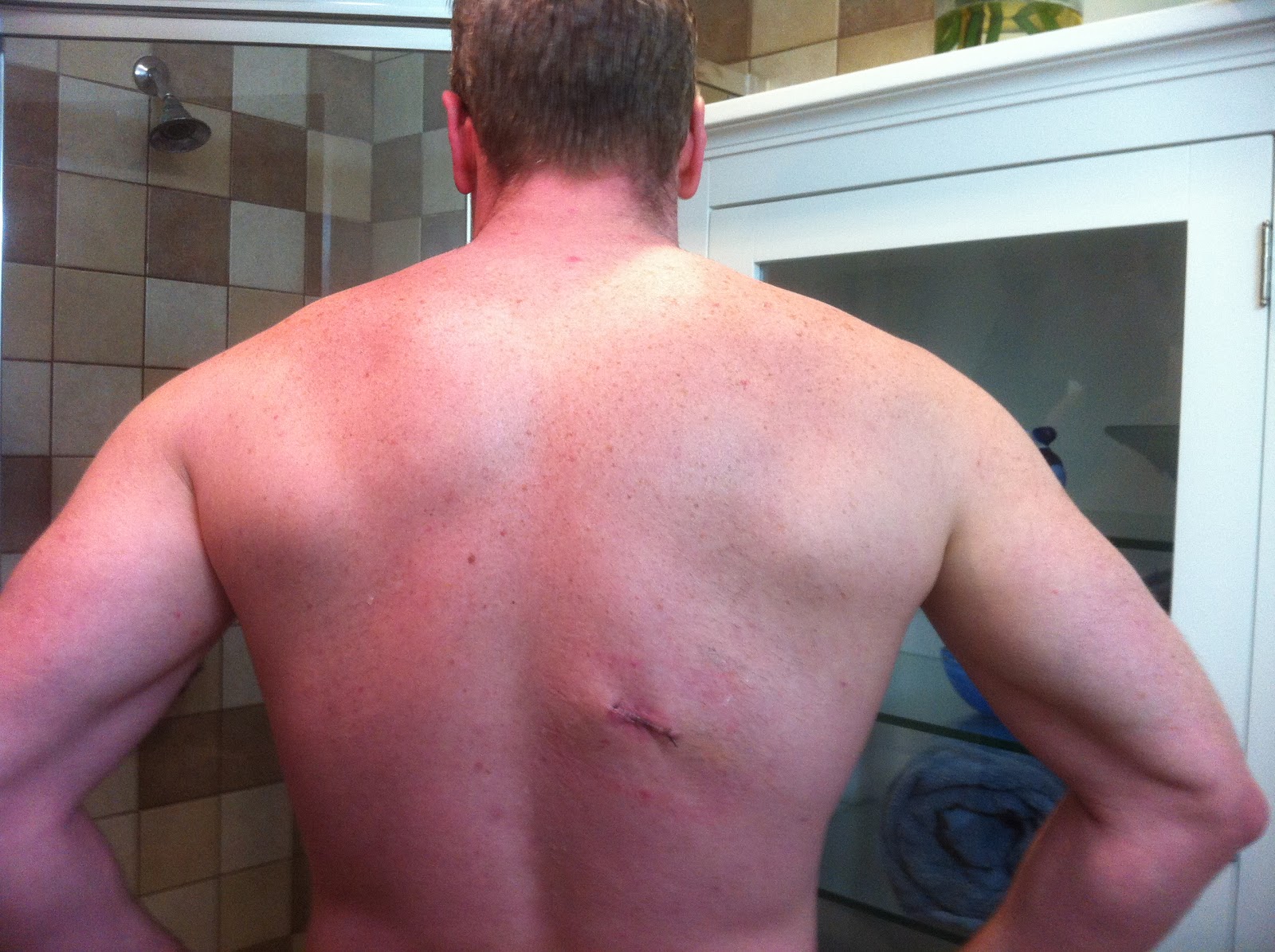
The nurse on the phone explained to me that I needed to come back in, and after some questioning from me, I was told that my biopsy was moderate atypia and was not clear in the margins. So, on Tuesday of this week, I went in for surgery, foolishly believing that I'd be able to go straight to work and resume a normal life immediately afterwards. It turned out he had to cut a lot more off of my back than I realized and the mole had grown inward enough that he had to cut into the second layer of skin--as we chatted during the surgery, he explained that since he had to cut into that second layer, he had to go all the way through it so that it would close properly. He put 6 internal stitches in the second layer of skin, and 13 in the first. I'll find out if he got all of the atypical cells out in a couple of weeks.

So, that's what it took to take the not-cancer out of me. Some people have asked what this means, and some have assumed that because of the size of the cut that I have had skin cancer removed--I haven't. Moderate atypia is a precursor to skin cancer that doesn't always evolve into skin cancer. The only hard statistic I've been able to find is that about half of diagnosed malignant melanomas arise from moderately atypical moles--the other half, I assume, look like melanoma right from the very beginning--I will call those the douchiest melanomas.

I've thought a lot about why I'm in this position--some of it is genetics, just because I'm pale enough to make some off-white wedding dresses look tan. Some of it is bad luck, and some of it is sun exposure. Though I have to say there's not a whole lot that's different about my sun exposure history than most. I remember a single blistering sunburn as a child, and that was on my shoulders--I have never had anything removed from my shoulders. I spent my high school and college years as a swimmer--but only two of those years had a significant amount of time in an outdoor pool. At Pine Crest, I swam from 4pm to 7pm every weekday in the south Florida sun, and 7am to 11am on Saturdays. The morning weekday workouts were before the sun came up, so I can't blame those. Perhaps those two years were enough to do the lasting damage to my skin that exists now. I'm a triathlete, so I get some continuing sun exposure throughout my life, though anyone I train with knows I sunscreen to the point of being a nuisance. I'm not perfect and occasionally screw up. I've had a mild sunburn once in the past 4 years. And sunscreen washes off in a pool regardless of how much it says that it's waterproof, so for an hour and half workout, I'm getting some sun exposure. Thankfully, my dermatologist is a realist, and tells me to live my life but do what I can to protect my skin from the sun--continue sunscreening--continue training, and don't sweat the small mistakes.

My opinion? We're all living on borrowed time past the age of somewhere in our mid-30s. From an evolutionary standpoint, the human body doesn't need to survive past the point of the significant reproductive phase of its lifespan, which starts with adolescence, and ends with the reduction of fertility on the female side of the species (mid 30's--ticking biological clock, etc...) Even though I'm male and that part doesn't explicitly hit me, the human race doesn't need older males to reproduce. So we're all degrading as time goes by, and modern medicine has made many significant advances in keeping us alive longer. Anyone who's an adult approaching their 40s can likely point to things that would have killed them without medical intervention--it may be simple for some, and more complex for others. In my case, I've got some early detection of potentially pre-cancerous skin growths in addition to some rounds of antibiotics and the removal of my appendix. They're keeping me alive and hopefully helping me to avoid some more significant issues later on with what these moles might have become.

So let's hear it for modern medicine keeping us going!  Even if that does mean some nasty looking stitches along the way.

Wednesday, January 23, 2013

The next step in Plantar Fasciitis


My issues with plantar fasciitis have spanned more than a decade, but this recent bout with it has been going on for about 8 months now. I've just made the decision to bail out of the Surf City Half Marathon since my pain from running was escalating rather than improving. The last race I was in was July, which means I've been on the sidelines for a good 7 months now.

I'm very certain I could end the pain in my feet in a few seconds given a chainsaw, a bottle of Jack Daniels, and someone to clean up all the blood, but that might cause some undesirable issues. As opposed to something that radical, my coach suggested something earlier this week called "dry needling," and I (of course) responded that it scared the hell out of me. The concept is similar to acupuncture, in that needles are inserted into your body, but unlike acupuncture, the purpose is not to cause changes in the energy systems of your body, but to actually do physical things to your muscles. In some cases, dry needling is actually supposed to cause damage, so that your body can heal itself properly--and in other cases, it's supposed to actively release muscles by stimulating trigger points in them. A case study I found piqued my interest--by repeatedly puncturing the plantar fascia, a trial produced a 95% cure rate for its subjects. Anyone who has dealt with plantar fasciitis is likely to understand that this is probably 94% higher than most conventional methods for dealing with it.

It turns out that the state of California is in the dark ages when it comes to dry needling. Our government explicitly bans the practice by physical therapists, who are the health care professionals that do this in at least some other states in our country. So, I started looking to see if I could find acupuncturists that perform this procedure, and I came up dry (pun very definitely intended). I gave up on this glimmer of hope for rapid recovery, and focused on what I've been doing--stretching, strengthening, and more not-running.

Joanna, my triathlon coach, wound up suggesting to me to give a straight-up acupuncturist a try--and very correctly identified that the myriad of issues that I have might be aided by this type of treatment.  Stress, insomnia, depression, anxiety, and long term pain have all been shown to be improved by acupuncture.  I really like that she was able to take a step back, look at the bigger picture, and wake me up by pointing out to me what might be glaringly obvious to some people--"You have bigger issues than your foot."  Well, she didn't quite say it that way, but that pretty much sums it up.

So I redoubled my efforts in looking for an acupuncturist--and failed again this morning. I posted on Facebook wondering if any of my friends knew of anyone they'd recommend, and it turns out that Brian was the person to respond, and his recommendation is an athlete that's a licensed acupuncturist who has experience treating plantar fasciitis through trigger point dry needling. Sometimes the answers lie a lot closer to home than you think they do.

I'm looking forward to getting in for an appointment--and maybe fixing some of my issues.  More posts to come!