Sunday, October 5, 2014

Sunday, September 28, 2014
The lone cyclist
 Something I came to terms with a few years ago was making a decision between training and riding, and when it comes down to it, it's a decision I've continued to have to make on a very frequent basis. When I started working with my coach, Joanna Zeiger (racereadycoaching.com), the way I approached cycling workouts didn't just change--it was upended, torn apart, and put back together again all over the course of that first year that she coached me. I got a power meter, and I struggled with it. At first, I struggled to even grasp what I was supposed to be accomplishing with the numbers that seemed to be only tangentially related to what I thought was going on with me on the bike.
Joanna was very patient with me, and took me through several of my power files over time, and explained what the issues were. In retrospect, it really wasn't surprising. Cycling, in general, does not lend itself to encourage you to do what you should actually do to get better. When you ride in a group, you really have no control of what kind of effort level you're putting into the pedals, and more than likely, you wind up riding too hard on uphills, and way too easy when sitting in the draft zone of even a single cyclist. Your workout tends to look like a mess of random garbage that doesn't really train your muscles or the energy systems that supply them in order to make you go faster. Over the course of years, I've discovered that most cyclists tend to double, if not triple, their power output when going up a small hill. As an example--you're pedaling along at something close to your long distance aerobic pace--let's say 150 watts, and when you reach a hill, you feel the need to maintain your speed, and testosterone kicks in, because who wants to be the one to slow up the pack going up a hill? It's not uncommon for me to sit in the back of the pack when this occurs and watch how I have to break 300 watts and approach 400 watts or even more just to stay on someone's wheel. So, you've gone from something you can probably maintain for 5 or 6 hours, to something you wouldn't be able to maintain for 5 or 6 minutes, all based on the randomness of the road. There simply isn't another sport that this happens in.
 |
| An example of a pretty decent power file, with a 20 minute long interval in the middle of it |
 I don't crank through workouts that way anymore--if I ride with a group, which is rare, I tend to hang in the back, and drop off the pack going up a hill. I'll catch them on the downhill or a flat that follows. When I do ride with a group, it's usually for a workout that I'm not trying to accomplish something specific, or it's for a portion of the workout that my effort level can change--the warm-up is usually an ok place/time for me to do that. The simple fact of the matter is that I watched myself take an hour and a half off of my ironman bike split when I trained correctly, and that's what I was after all along. I've found that most people in triathlon don't actually want to ride like that--they're there for the group ride--and to have fun, which is perfectly ok. I just decided a long time ago that triathlon was about setting and achieving goals for me, and doing what I need to do to make that happen. So I wind up riding alone--a lot. Occasionally, someone rides with me, and does one of my workouts with me, but it never seems to stick--while I can guess as to the reasons why, I don't actually know in a lot of cases, because we're all out there for a different reason.
So, it's time for me to get out of my head and get on my bike, for a long ride with some long intervals at half-iron pace. Ride on and be safe everyone!
Sunday, September 14, 2014
"Hi, my name's Drew and I'm a recovering swimmer from the '90s"
I grew up in the age of "You will swim 17,000 meters a day, and if you don't get good from it, that's your problem." This has left a lasting impression on my life that is flawed to its very core. On one hand, the work ethic that swimming taught me was unparalleled to anything I probably could have gotten as a child, and that's saying a lot, given that I grew up in a military household where sitting around and relaxing was viewed as a cardinal sin. On the other hand, it mistakenly taught me that more is always better, and it has taken me decades to unlearn, and something that I still struggle with on a daily basis.

I was lucky going through school because it was easy for me--people used to get really pissed at me when I explained to them that the amount of time I spent studying for exams was on the order of minutes, as opposed to hours or days in some cases. It was simply very straightforward for me to identify what I didn't know, review that, and be done with it. My test scores, grades, and acheivements all reflected that, and I carried this into my professional life. The only difference was that time became measured in hours worked, rather than in tasks accomplished, and I set out at a very early time in my career to fill my days with the most productive time I could, rarely exceeding a 40 hour workweek and often outperforming my peers in the process of doing so. I'm only saying this to point out that somehow I was lucky in not letting the lessons that were ingrained in me as a swimmer carry through to my career.
I am, however, extraordinarily hard on myself in my activities outside of work. Joanna, my triathlon coach, has pointed this out to me, and she has been dead on. If I am not exceeding the bounds of reality of what my body can handle, I am not happy with the results of my workouts. If I am not constantly achieving new PRs, I am not satisfied with my race results. If I'm not doing all of this while I'm holding down a job as an aerospace engineer, where I am routinely faced with the realities of a contracting industry laying off workers left and right, then I have failed.
I think that the lesson that I had to learn, and still have more to learn about, is that sometimes non-perfection is good enough. Beating myself up for ending my workout yesterday after a wasp sting is not productive, and given the black-and-blue mark I have on it today, I probably didn't need to finish my hard intervals while riding home.
I'm not going to the Olympics, and given that I'm about 3 hours out of contention for a Kona slot, I'm not going there either. The daily struggles that I have with performance have to be more about enjoying the process, rather than focusing on the result, and I think I've lost touch with a lot of that--so I was all too happy this morning when a brief bout of runner's high kicked in during my 10 miler, and I could remember what it's all about.
It's time to just enjoy the day.

I was lucky going through school because it was easy for me--people used to get really pissed at me when I explained to them that the amount of time I spent studying for exams was on the order of minutes, as opposed to hours or days in some cases. It was simply very straightforward for me to identify what I didn't know, review that, and be done with it. My test scores, grades, and acheivements all reflected that, and I carried this into my professional life. The only difference was that time became measured in hours worked, rather than in tasks accomplished, and I set out at a very early time in my career to fill my days with the most productive time I could, rarely exceeding a 40 hour workweek and often outperforming my peers in the process of doing so. I'm only saying this to point out that somehow I was lucky in not letting the lessons that were ingrained in me as a swimmer carry through to my career.
I am, however, extraordinarily hard on myself in my activities outside of work. Joanna, my triathlon coach, has pointed this out to me, and she has been dead on. If I am not exceeding the bounds of reality of what my body can handle, I am not happy with the results of my workouts. If I am not constantly achieving new PRs, I am not satisfied with my race results. If I'm not doing all of this while I'm holding down a job as an aerospace engineer, where I am routinely faced with the realities of a contracting industry laying off workers left and right, then I have failed.
I think that the lesson that I had to learn, and still have more to learn about, is that sometimes non-perfection is good enough. Beating myself up for ending my workout yesterday after a wasp sting is not productive, and given the black-and-blue mark I have on it today, I probably didn't need to finish my hard intervals while riding home.
I'm not going to the Olympics, and given that I'm about 3 hours out of contention for a Kona slot, I'm not going there either. The daily struggles that I have with performance have to be more about enjoying the process, rather than focusing on the result, and I think I've lost touch with a lot of that--so I was all too happy this morning when a brief bout of runner's high kicked in during my 10 miler, and I could remember what it's all about.
It's time to just enjoy the day.
Sunday, August 31, 2014
Work/Life/Triathlon Balance
 |
| Notice how "work" has a higher point value... |
I just complicate the issues by adding in an on-going pursuit of triathlon. There have been times in my life when everything to do with this sport clicks together with my personal life--I have wound up with friends training with me--the workouts have been enjoyable--triathlon becomes a path of life that seems to fit and fill in a part of my life that helps to achieve that balance without taking anything away.
There have also been times when nothing seems to work. I wind up plagued with injury--my friends have disbanded, so I'm training on my own--my workouts become a source of stress and anxiety instead of stress relief and a near meditative state. All of this goes on while my career does what it does, which is to go through the cycles of stress and reward that it does--as everybody's career does.
I think all of this kills me when the three major things in my life all go into a synodic intersection of a spiral of death at the same time. My career has become a source of stress again--I just had a series of workouts that kicked my ass following a series of subpar performances at Gay Games--and I did them all on my own...mainly because no one I know wants to do a four hour long brick workout if they don't have a half ironman sitting on their schedule in the very near future. Today, some of my friends headed out for drinks at the Faultline, and I decided against going because I'd lost seven pounds of bodyweight during my run this morning, and couldn't get my shit together to get my swim done in time to be able to meet them. I'm insane--I realize that...it's just possible there's a reason why this guy that I dated many years ago had friends that told him "Gay rocket scientist triathlete? Does not exist." But there are probably many of us, actually--and we're all equally insane. And frankly, I just don't understand how anyone with children does any of this--some people are simply superheroes.
But I'm not that strong--I cannot keep my shit together at a time such as this. So I just have to cope day by day. And search for a light at the end of the tunnel. Find some new people to train with, wait for the aerospace cycle of death to turn around, and hope that the climb out of this quagmire is imminent. Besides, I've got an appointment with a new therapist on Thursday. By Friday, I should be completely fixed.
Visualize puppies and rainbows.

Monday, August 11, 2014
Gay Games 9 Triathlon--A New Beginning
It's been a long time since I've written in my blog--I can name countless reasons why I haven't. Brian and I sold our old house and moved to a new one, work stress has grown, we've had way too many issues going on with our dogs, Josie and Max, and frankly, I've just been a little overwhelmed with things. And I would be lying if I didn't say that my issues with depression have played a role in dealing with things.
 I'm currently at Gay Games 9 in Cleveland, Ohio, and yesterday competed in the Olympic Distance Triathlon. My performance was excellent, but the outcome of the race was not--to sum it up, the race course was not clearly marked on the run, and I didn't know beforehand (as I should have) where the double-back loop was supposed to occur. It turns out that the loop was supposed to be doubled over the 2 miles of the beginning of the run course, so by the time I'd identified something was wrong (within half a mile of the finish line) there was nothing I could do. Following the finish, I waited to find someone else who had done the Olympic distance race and figured out where my mistake was. I immediately knew that I had to ask the officials to disqualify me--the finish time that I was given would likely have been the fastest overall and robbed people of the medals they rightfully deserved.
My bike split was an average of 213 watts over a hilly course, and lacked the characteristic peaks and valleys in power that I have typically had problems with on this kind of course--it was a better ride than anything I have done in years. And my run was going extraordinarily well--I ran 8:30s for the first four miles, and was prepared to finish strong for the last 2.2. If I take a look at where 8:30s would have placed me in the final standings, I would have wound up second in my age group--but 2nd and 3rd in my age group go to the people who actually took the time to know the course beforehand, as they should.
 |
| Bike power--The dips under 100 watts are the turnarounds at the far ends of each of the 3 loops |
 So, I'm back in the shape I was before my injuries and probably even much faster than that. My injuries are under control, and well on their way to being completely non-factors in my performance. In the past couple of months, the path that Joanna and I have taken is to address the muscular imbalances and weaknesses in my glutes, hamstrings, and core that so many triathletes have from excessive overuse in biking and running. These new exercises seem to not only be fixing my problems with injury but also unlocking new speeds I have not seen before.
 I'm excited to keep on racing--Up next is 5 events plus 3 relays in Gay Games Swimming!
 Tuesday, December 31, 2013
Thoughts on my last run in DC this year


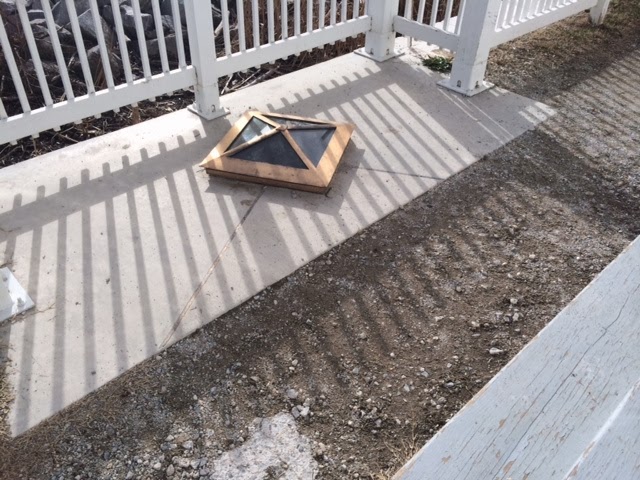 On my final run while I was in DC, I decided to stop and take some time to explore this weird area, and found out very quickly that it is a place called "Jones Point Park." A concrete marker just south of the lighthouse at Jones Point sets the very southern tip of the DC area, and some history explains that this occurred when Maryland ceded its land to create the District of Columbia. This photo shows the lines of demarcation between Virginia (right side of photo), D.C. (area in the center), and Maryland (left side of the photo).
 So as I was standing there, taking a break from my run, I realized how petty all of this actually is--I was standing in a spot half in and half out of an area that recognized my marriage and thinking about how important that was, while in the not so distant past, it signified where and when it was acceptable for one man to beat and torture another, and use him until he was dead for something no more significant than the color of his skin.
 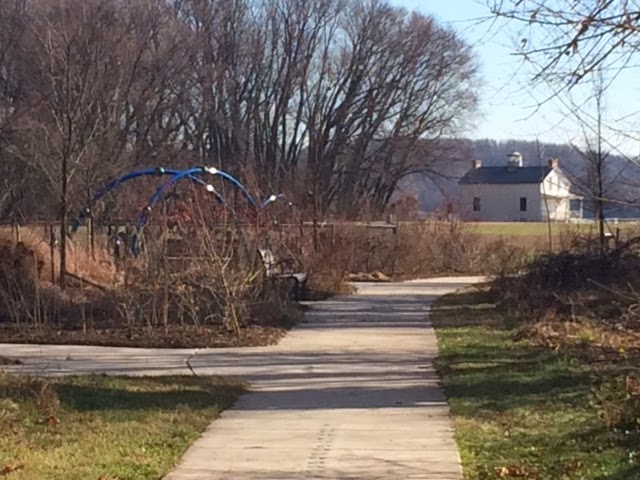 I would like to think that our society has evolved past a point of racism, and past a point where little differences between people's heritages make a difference, but the reality is that we haven't. Black Americans have had full legal rights for many years now, but are still discriminated against on a daily basis. People are singled out on the basis of their ethnicity, their religion, their sexual orientation, and a huge list of differences that really don't matter because we are all people. It's time we got over this--we are bound to repeat the mistakes of our past, not because we didn't learn our history, but because we didn't understand what it meant.
So I finished my run, and then I got home from my business trip a couple of days later and told my husband that I love him. I think that's the most important thing we can all do.
Sunday, October 27, 2013
The Spine-athalon
“We need to say ‘I love you’ more,” was what my husband told
me as he lay in the recovery room immediately after having his L5 and S1
vertebrae fused. Or rather,
immediately after having his disc in between his L5 and S1 vertebrae removed
and an artificial cage with scaffolding put in place instead. Spinal fusion is not something that
happens during surgery, but something that occurs during the long, arduous
months that follow surgery, as your body heals as a result of the actions taken
by a surgeon. In the meantime, you
spend a lot of time lying around, being mostly incapacitated and waiting and
hoping for the spine to fuse.
Brian has taken to watching a lot of movies.

But the beginning of post surgery is something that took me
aback—right from the very few seconds that I saw him. I was lucky enough to be allowed in the post surgery
recovery area, and they let me in to see him as early as they allow anyone—and
immediately when I saw him, I could tell the effects of anesthesia were still
with him, and the effects from the morphine they were giving him added to
it. Brian babbled—he talked about
some of the most ridiculous things….’I need to buy new sheets’…’I want to
organize that shelf in my room’…’I’m in pain…it’s a four’ (I had to tell his
nurse to double any estimate of pain he was giving her)…and the one that really
stuck with me: ‘We need to say ‘I love you’ more”…and we do. And that’s mostly
because everybody does—but more because, as men, we tend to have a gender-biased
assumption that “If I told you I love you once, and I haven’t told you otherwise,
then it hasn’t changed.”
Ugh…me…caveman.
I spent a long time debating about whether to tell him about
this, because I’m very certain that he doesn’t remember anything from that time
in the recovery room—I didn’t figure this out until a day later when I was
telling about our friend Jeremy and asking if he’d talked to him since those
text messages in the recovery room.
He had absolutely no recollection of the subject.
The time that follows a spinal fusion is nothing short of a
roller-coaster ride. Brian spent
the first couple of weeks talking in his sleep—I’m not capable of telling you
what he said, because it was completely incomprehensible, aside from a couple
of “What the fuck?” statements. He
had episodes of horrible stabbing pain…he had constant less intense pain. He spent 5 days figuring out how
to get his lower GI tract back to normal, and it turns out prune juice was his
savior. Doctors tend to like
to prescribe things—colace and milk of magnesia didn’t do shit for him. (Pun very much intended)
 His care has taken a lot of my time as well—in the first
couple of weeks, he was barely capable of moving around the house, so every meal,
every drink, and some nurse-maid duties such as the male porta-urinal were all
des rigueur. I had to leave for
work for about two and a half weeks after that, and he somehow managed to
survive. I’d made frozen meals for
him from Dream Dinners and we worked out that he was able to place them in our
above stove combo microwave/convection oven. We set everything we could at waist level or above—he is
still not allowed to bend down to pick anything up for any reason. I owe a huge debt of gratitude to
all of our friends that came by during that time—you all saved him.
His care has taken a lot of my time as well—in the first
couple of weeks, he was barely capable of moving around the house, so every meal,
every drink, and some nurse-maid duties such as the male porta-urinal were all
des rigueur. I had to leave for
work for about two and a half weeks after that, and he somehow managed to
survive. I’d made frozen meals for
him from Dream Dinners and we worked out that he was able to place them in our
above stove combo microwave/convection oven. We set everything we could at waist level or above—he is
still not allowed to bend down to pick anything up for any reason. I owe a huge debt of gratitude to
all of our friends that came by during that time—you all saved him.
We saw a glimmer of the road ahead the other night by going
to our friends’ Steve and Colvin’s wedding. Some fun times at a point about 8.5 weeks after
surgery—Brian had to alternate between sitting for a while and standing for a
while the whole time we were there, and he loved being at dinner (and congrats
again Colvin and Steve!) Riding in
a car is still a very limited activity though.
I’m particularly worried about how the next couple of months
go because everybody refers to it as the danger-zone in this healing
process. People tend to feel
better and push too hard. Brian’s
exhibiting some symptoms of wanting to do that, but so far, he’s kept his head
on straight. He’s allowed to
walk in the shallow end of the pool for 20 minutes a few times a week, but
otherwise, his only other exercise is his 1 or 2 twenty-minute walks around our
neighborhood each day. There’s
still no bending, no picking up Max’s pills off the floor if he drops them—no
actual swimming, and no significant riding in a car.
I’m currently sitting on a plane for another work trip,
trying not to feel guilty about the two workouts I missed yesterday while I was
putting the house in order for him to be alone again. My return to triathlon training hasn’t so much been affected
by this as it’s just been a little slow—occasionally, there is just too much to
do in a day, and that’s ok. It’s
entirely possible that this slow readjustment to training has been what’s
keeping me from reinjuring myself—life can work that way sometimes.
Subscribe to:
Posts (Atom)