Sunday, April 21, 2013

I am an addict.

It will come as no surprise to people who know me when I say that I am completely, horribly, and happily addicted to caffeine. My relationship with the substance began my freshman year in college, and never let go--like so many people in the world, it's what gets me going in the morning, boosts my mood, and makes me a more productive person. The consumption form of choice for me is coffee and espresso, both black. Sugar and milk mar the taste of perfection for me.

I'm not here today to debate the pros and cons of caffeine consumption--let's just say that if I did, I would weigh heavily on the pro side, and have a very difficult time coming up with an unbiased argument. I'm here to simply state that I've had a long history of overdoing it, and a little moderation is required.

I've laughed in my doctor's face when he has suggested getting off of it entirely--armed with some simple facts, he's let it go after I quickly retorted. There's only a casual association of caffeine consumption with high blood pressure, and the medical literature basically states that increased blood pressure is a transient response present in caffeine-naive individuals--simply put, if you're going to drink it, drink it all the time and drink it consistently. My issues with depression kick into high gear during caffeine withdrawal periods. He backed off immediately after hearing that.

My kick-ass espresso machine
My problem is that it's been too much, and not well timed through the day. In the height of my most recent peak with it, I was putting down 12 shots of espresso a day--somewhere between 900 and 1200 milligrams of caffeine, which far exceeds the maximum recommendation of 300-500 milligrams of consumption per day. Even I could not argue with the idea that this was probably contributing to my issues with anxiety, inability to sleep, and generalized grouchiness. In my defense, I had just bought a new espresso machine, and the stuff was delicious.

So, about a year ago, I tapered it down to 6 shots a day, and things got better. Still consuming between 450 and 600 mg of caffeine a day until about a week ago, I continued to have some issues with sleeping, though not nearly as severe as I've had in the past. My most recent look at this was brought about by some of my friends buying me a pound of something called "Death Wish Coffee," which is a brand of coffee made entirely from the Robusta variety of coffee beans, and those beans contain about twice as much caffeine as the more typical Arabica beans. I tried it out one morning, and had two cups of this coffee instead of my usual four shots of espresso--the result was that I did not sleep at all that night.

Tassimo--Creator of the "weak" coffee I drink in the afternoon
My heightened detective skills were put into play to come to the conclusion that my two cups of Death Wish coffee had not been metabolized by my body over the course of 16 hours, and I drew the conclusion that my issues with getting to sleep in general were probably due to having too much caffeine in my system when trying to get to bed.

I've now been one week with dropping down from 6 shots to 5 shots of espresso a day (or sometimes 4 shots of espresso in the morning, and an equivalent "weak" cup of coffee in the afternoon). Sleeping seems to be going better, but the real results won't be in for a while, after I've gotten through the adjustment period and I've seen what the long term effects of the change are.

Saturday, April 13, 2013

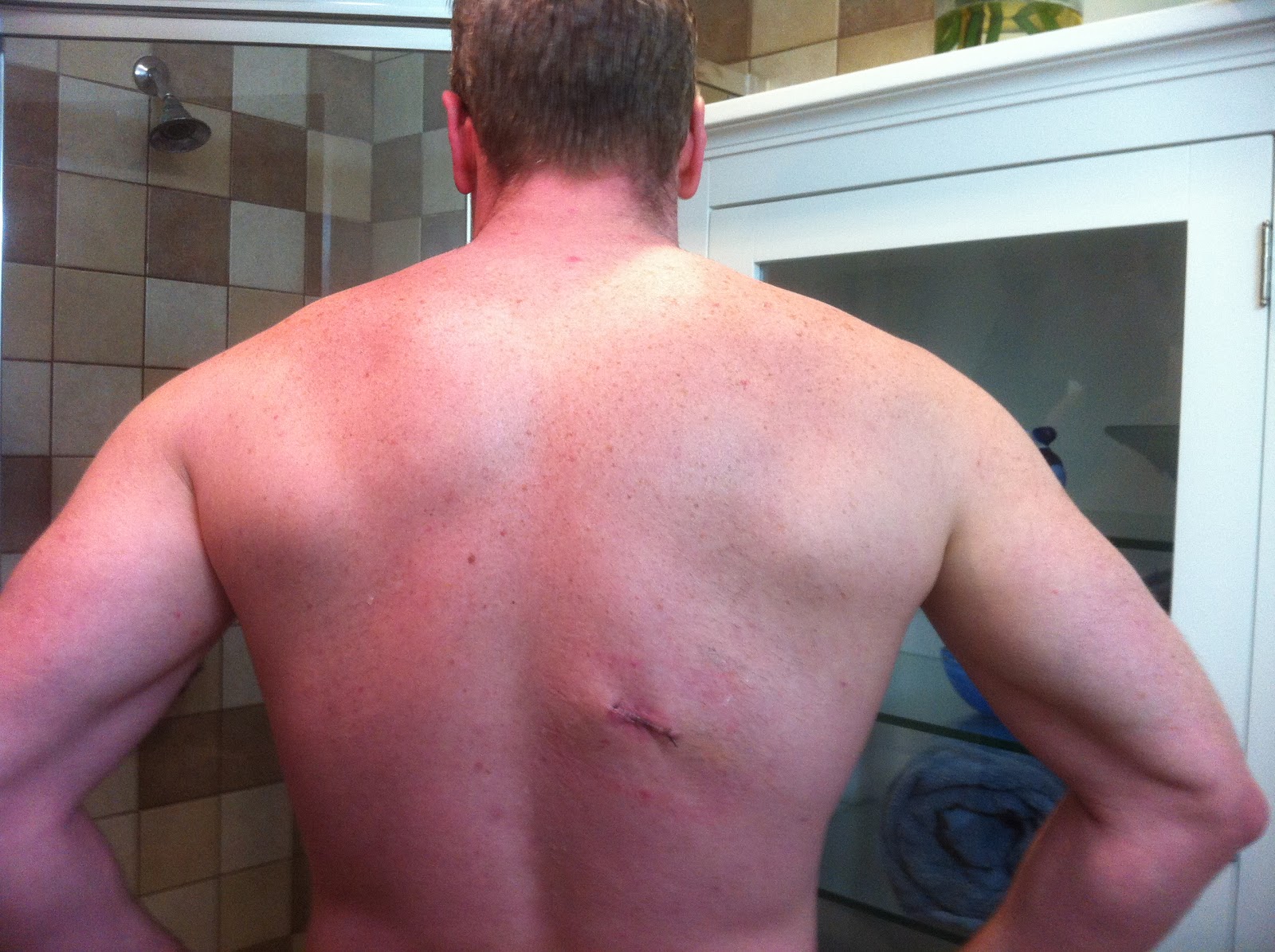
This is where they took the not-cancer out...

About a month ago, I went in for a routine mole check with my dermatologist--I'd made it a habit to go in for the screenings every 6 months about 10 years ago. The first time I saw him, he found something suspicious, and scalpel biopsied it. It came back as moderately atypical, and had to be further removed with what I'll call a punch removal system--they have this device that carves out around the mole. Then, they lift it up and slice it from underneath, leaving something that looks like a paper punch in your skin. They stitch this up and send you on your way. That time, the removal came back as clear in the margins, and I was done.

Since that time 10 years ago, he's decided to take off one other mole that wound up being suspicious, but he got that all completely off with the first scalpel biopsy. Aside from that, it's been a couple of false starts initiated by me--things like a mole on my neck that started bleeding, which turned out to be nothing. A spot on my face, which was (embarrassingly) nothing more than a scar from acne.

A month ago, the thing he took off looked completely innocuous, and he said it would be unlikely to be anything serious. I took this to mean that, if anything, the atypical part was small, and he probably got it all out with margin with that single cut. The location on my back, being just underneath the shoulder blade and close to the spine made it too painful to swim for a couple of days following the excision, but after that, I was back to normal...until I got a call that I needed to come back in for more work.

The nurse on the phone explained to me that I needed to come back in, and after some questioning from me, I was told that my biopsy was moderate atypia and was not clear in the margins. So, on Tuesday of this week, I went in for surgery, foolishly believing that I'd be able to go straight to work and resume a normal life immediately afterwards. It turned out he had to cut a lot more off of my back than I realized and the mole had grown inward enough that he had to cut into the second layer of skin--as we chatted during the surgery, he explained that since he had to cut into that second layer, he had to go all the way through it so that it would close properly. He put 6 internal stitches in the second layer of skin, and 13 in the first. I'll find out if he got all of the atypical cells out in a couple of weeks.

So, that's what it took to take the not-cancer out of me. Some people have asked what this means, and some have assumed that because of the size of the cut that I have had skin cancer removed--I haven't. Moderate atypia is a precursor to skin cancer that doesn't always evolve into skin cancer. The only hard statistic I've been able to find is that about half of diagnosed malignant melanomas arise from moderately atypical moles--the other half, I assume, look like melanoma right from the very beginning--I will call those the douchiest melanomas.

I've thought a lot about why I'm in this position--some of it is genetics, just because I'm pale enough to make some off-white wedding dresses look tan. Some of it is bad luck, and some of it is sun exposure. Though I have to say there's not a whole lot that's different about my sun exposure history than most. I remember a single blistering sunburn as a child, and that was on my shoulders--I have never had anything removed from my shoulders. I spent my high school and college years as a swimmer--but only two of those years had a significant amount of time in an outdoor pool. At Pine Crest, I swam from 4pm to 7pm every weekday in the south Florida sun, and 7am to 11am on Saturdays. The morning weekday workouts were before the sun came up, so I can't blame those. Perhaps those two years were enough to do the lasting damage to my skin that exists now. I'm a triathlete, so I get some continuing sun exposure throughout my life, though anyone I train with knows I sunscreen to the point of being a nuisance. I'm not perfect and occasionally screw up. I've had a mild sunburn once in the past 4 years. And sunscreen washes off in a pool regardless of how much it says that it's waterproof, so for an hour and half workout, I'm getting some sun exposure. Thankfully, my dermatologist is a realist, and tells me to live my life but do what I can to protect my skin from the sun--continue sunscreening--continue training, and don't sweat the small mistakes.

My opinion? We're all living on borrowed time past the age of somewhere in our mid-30s. From an evolutionary standpoint, the human body doesn't need to survive past the point of the significant reproductive phase of its lifespan, which starts with adolescence, and ends with the reduction of fertility on the female side of the species (mid 30's--ticking biological clock, etc...) Even though I'm male and that part doesn't explicitly hit me, the human race doesn't need older males to reproduce. So we're all degrading as time goes by, and modern medicine has made many significant advances in keeping us alive longer. Anyone who's an adult approaching their 40s can likely point to things that would have killed them without medical intervention--it may be simple for some, and more complex for others. In my case, I've got some early detection of potentially pre-cancerous skin growths in addition to some rounds of antibiotics and the removal of my appendix. They're keeping me alive and hopefully helping me to avoid some more significant issues later on with what these moles might have become.

So let's hear it for modern medicine keeping us going!  Even if that does mean some nasty looking stitches along the way.

Wednesday, January 23, 2013

The next step in Plantar Fasciitis


My issues with plantar fasciitis have spanned more than a decade, but this recent bout with it has been going on for about 8 months now. I've just made the decision to bail out of the Surf City Half Marathon since my pain from running was escalating rather than improving. The last race I was in was July, which means I've been on the sidelines for a good 7 months now.

I'm very certain I could end the pain in my feet in a few seconds given a chainsaw, a bottle of Jack Daniels, and someone to clean up all the blood, but that might cause some undesirable issues. As opposed to something that radical, my coach suggested something earlier this week called "dry needling," and I (of course) responded that it scared the hell out of me. The concept is similar to acupuncture, in that needles are inserted into your body, but unlike acupuncture, the purpose is not to cause changes in the energy systems of your body, but to actually do physical things to your muscles. In some cases, dry needling is actually supposed to cause damage, so that your body can heal itself properly--and in other cases, it's supposed to actively release muscles by stimulating trigger points in them. A case study I found piqued my interest--by repeatedly puncturing the plantar fascia, a trial produced a 95% cure rate for its subjects. Anyone who has dealt with plantar fasciitis is likely to understand that this is probably 94% higher than most conventional methods for dealing with it.

It turns out that the state of California is in the dark ages when it comes to dry needling. Our government explicitly bans the practice by physical therapists, who are the health care professionals that do this in at least some other states in our country. So, I started looking to see if I could find acupuncturists that perform this procedure, and I came up dry (pun very definitely intended). I gave up on this glimmer of hope for rapid recovery, and focused on what I've been doing--stretching, strengthening, and more not-running.

Joanna, my triathlon coach, wound up suggesting to me to give a straight-up acupuncturist a try--and very correctly identified that the myriad of issues that I have might be aided by this type of treatment.  Stress, insomnia, depression, anxiety, and long term pain have all been shown to be improved by acupuncture.  I really like that she was able to take a step back, look at the bigger picture, and wake me up by pointing out to me what might be glaringly obvious to some people--"You have bigger issues than your foot."  Well, she didn't quite say it that way, but that pretty much sums it up.

So I redoubled my efforts in looking for an acupuncturist--and failed again this morning. I posted on Facebook wondering if any of my friends knew of anyone they'd recommend, and it turns out that Brian was the person to respond, and his recommendation is an athlete that's a licensed acupuncturist who has experience treating plantar fasciitis through trigger point dry needling. Sometimes the answers lie a lot closer to home than you think they do.

I'm looking forward to getting in for an appointment--and maybe fixing some of my issues.  More posts to come!

Tuesday, January 8, 2013

The Incredible Adaptability of Humans

I'm currently on travel for work in Oslo, Norway--which presents a number of challenges for training in general, not the least of which is the cold weather.   Before going any further in this description, it's important to realize I am a cold-or-wet-weather-chickenshit-pansy when it comes to training.  Before my last couple of years of training, I would prefer to run 16 miles on the treadmill than risk getting a little wet from running in the rain.   Getting caught in the rain on a bike was simply unacceptable, so if there was any chance of precipitation during the few months of potential rain that there is in Los Angeles, I simply wouldn't get on my bike. 

My coach, Joanna, has slowly made some progress in helping me to let go of some of this wimpiness of mine, but I'm certain if she's reading this, she's thinking I've got so very far to go.   To be clear, I'm pretty certain my balls shrivel up into tic-tac size nubs and I transform into a sniveling little cry-baby whenever the temperature drops into the 50's or a light mist approaches my training venue.   Mom????  Got any hot chocolate?

So, I went running in the cold the other day in Oslo--it was just below freezing, which is unseasonably warm for the city for this time of year.   I was decked out in warm running tights, a long sleeve sleeve running overshirt, a hat, gloves, and some smartwool socks.   Other people were dressed in virtually identical clothing on the running trail--I nailed it!   Of course, my hands got a little cold and my lungs aren't used to breathing the cold air so it was a bit of a different experience, but I was very proud that I dressed as the locals do when they run in this type of weather.

But the thing I couldn't get past is that I saw a couple of people on bikes in this weather.   They were dressed warmly, but there were patches of snow, ice, and slush on the ground.   In my mind, this would make for an immediate free-pass from biking outside, and that's when it hit me.   People adapt to their surroundings in every way, in every efficiency possible.  It's cold, snowy, and dark here a substantial part of the year, and for people to not find a way to adapt to this would mean giving up what they enjoy doing.    This is their normal, while my normal is 72 degrees and sunny.   

For the record, I'll be glad to get back to California sometime in the next week--but in the meantime, I'll approach the cold weather with a little less disdain.

Tuesday, January 1, 2013

Wrapping up my year and the LA River Path

I had several high school English teachers tell me that writing would be my way of dealing with things as I grew up.   Some told me things as simple as "You're going to get bored with science and math, and need a creative outlet" and others were a little bit darker about it saying things along the lines of "Writing is your therapy--I'll be very concerned about you if you stop."   It's interesting to me how teachers can take a look at a young kid and sometimes nail their personalities on the head.   I haven't been writing recently--but I think I need to start again.  This post is all about the therapy side of it.

Yesterday, I was riding my bike down the LA river path, which is where I have done the majority of training that has made me the better cyclist that I am now.  In Los Angeles, there are very few areas that you can ride for any significant period of time without encountering stoplight after stoplight after stopsign after stoplight.   I've long known that areas of the LA river path are unsafe from the perspective that they run through low income neighborhoods and are claimed as territories by gangs in the city.   My partner was once mugged within a mile of our house while out for a run on this path in broad daylight.  He got away physically okay but was shaken mentally to the point that he'll never run on the path again.  He only rarely rides a bike down the path, and only does that when riding with other people.  You don't get a gun pulled on you without having some lasting imprint placed on your psyche.

I left for my ride at about 2:30 in the afternoon--there was plenty of sunshine and it was a bit cool.  By Los Angeles standards, the 60 degree weather called for most people to break out their parkas and fur-lined boots.  My ride was going normally, and the path wasn't excessively crowded.  About 25 minutes into it, I saw a couple of teenage kids ahead of me and called out to them to signal I'd be passing them--they were riding one behind the other, and the kid in the back turned to look at me and then pulled to the left to let me pass--it's absolutely the wrong thing to do, but I've gotten used to people on this path not knowing what they hell they're doing and I'm often just glad when people do something to open up a pathway, even if it's not moving to the right so I can overtake them correctly.   The kid in the front moved to the left at the same time as the other one, so I proceeded forward.   As I was getting ready to pass the kid in the front, he started veering into me, and I started screaming my head off at him--no expletives at this point--I was just trying to get his attention.   I saw him yank a headphone out of his right ear, and he quickly followed up with "SHUT THE FUCK UP.  I'LL KNOCK YOU OFF THAT BIKE."

Something in my gut told me I needed to respond in-kind, or he might try, and in a split-second decision, I did just that:  I yelled back in a severely mocking tone:  "Yeah, I bet you could.  You SHUT THE FUCK UP."   I cleared his front wheel and accelerated as best I could.   The interchange that happened afterwards could make Andrew Dice Clay look like a good candidate for teaching preschoolers.   I got away physically ok, but realized in the minutes afterward that if my instinct had been wrong and he'd been carrying a gun, it would have likely ended very badly for me.  The simple fact is that when someone comes at you that aggressively for no good reason, there's something else going on--a mental instability?  A severe chip on his shoulder?  Or, what I believe to be the case--a feeling of superiority based on something like ownership of this territory.   This kid will likely go on to be one of the dregs of our society.  If he does not end up in prison, he will doing nothing good as a contributor to our lives in Los Angeles as a whole.

I pedaled on--I had 4 minutes left until the start of my first interval. I was approaching the 105, and as I shifted into gear for this effort, my power meter spiked to 300 watts--I immediately understood this to be an effect of the adrenaline coursing through me from my interchange, and managed to back this off to a much more reasonable 240 watts.   A minute or two into this interval--I saw, up ahead in the distance, a couple of children who were maybe 6 and 8 years old riding down the path.   I once again called ahead, and these kids both turned to look behind them.   The older one got out of the way to the left while the younger one put his foot down and seemed to just stand there, fairly far to the right on the path.   This also happens all the time on the bike path, but what occurred next I didn't expect at all.  

The younger kid decided to push his way across the path to who I assume was his older brother at precisely the instant that I'd committed to going through the fairly significant gap between them.  The gap closed--I would not be able to stop in time.  The two of them effectively blocked the entire span of the bike path, and I veered to the left to avoid smashing directly into them.  The exact words I screamed were "JESUS FUCKING CHRIST MOVE."   The younger kid half whimpered/half screamed.  I would not be surprised if he peed his pants.  The older kid moved his bike out of the way just before I had to make the decision to either smash into him or send myself careening down the incline to the LA river.  I pulled away and finished my 12 minute long interval.    I went on to finish this interval and then stopped my bike to turn around and send Brian a text message that said that I was certain I could not continue living here and riding a bike. 

If I didn't scar that 6-year-old mentally for life about riding bikes, I at least left him with the fear that there would be some monster bearing down on him at 23 mph anytime he's on that bike path.  Brian says it's good that he should learn that sort of thing, because people in the area don't respect cyclists on the bike path.   I don't know what to make of it--but I'm sure it's not the way I would have wanted to learn how to ride a bike as a kid.

Stupid stuff happens on bike paths everywhere--that's a constant rule that applies to every path in every locale in every city of our nation.  The rest of my ride went on with the usual density of getting around people who don't quite understand the rules of the road on a bike, but was without incident.   The problem here is that the violent, aggressive behavior of the first kid I dealt with seems to be unique to the low income/gang territory that the LA River Path travels through.   The second interchange, while completely innocent, may have been averted had those kids' parents taught them the basics of riding on a bike path.  The lower income families that use this path think it's a safe place to let their kids do whatever they want to since it's free of motorized vehicles--they simply do not care about the existence of cyclists on this path.

Whatever the case, the LA River path is not a safe place to ride, and I need to move on from it.  Brian and I have talked about moving to a better neighborhood, and the neighborhoods we've discussed lie closer to the San Gabriel river trail, which seems to suffer less from these issues.   The collapse of the housing market will make this move difficult at this time, so until we can make that happen, it looks like I'm spending a lot of time on my indoor trainer, or driving my bike to a safer place to ride.   I'm two-tenths of a mile from what should be an ideal place to ride, but miles from reality.

Friday, November 30, 2012

SPMS Champs Swim Meet

Today and the rest of the weekend, I'll be competing at the SPMS SCM Championship meet.  (Acronym decoder for those not "in-the-know"--SPMS:  Southern Pacific Masters Swimming, the swimming organization for old people in Southern California. SCM:  Short course meters, a 25 meter pool not typically used for competition in the United States, but a standard in most of the rest of the world.)

My thoughts on this:  I've been plagued with back and foot injuries that have really cramped my style for a while--I'm simply headed out here to have fun.   I've entered all sprint races, and I'll be swimming 6 individual events and 5 relays.    The catch here is that these are some of the races that were arguably my best events in high school and college.   My major goal is to go out, compete, have fun, and not get obsessed over performance or comparisons to the swimmer that I once was.   Anyone who sees evidence of me getting obsessed over these things--feel free to give me a good smack in the ass and tell me to stuff it!

As I went through workout last night, I came to the realization that I've spent the past several years training my body to keep going for races lasting 5, 6, or 13 hours--and that's just a little bit difficult to translate to races that last a minute or less than 30 seconds.   I mentioned this to Erin (Grunion Masters Team swim coach), and she gave me her recommendation for how I should warm up to have a good race--it flew in the face of how I warmed up for these races 20 years ago...but then, I'm a completely different athlete than I once was.   Effectively, the advice was to hit the race dripping wet from having just gotten out of the warm-up pool after swimming a set that would effectively be the beginning portion of descending to an all out effort, which I would do in the competition pool.   This stands in stark contrast to my days of warming up an hour ahead of time with a couple of 5 second sprints to the get the muscles moving, and then collapse somewhere and relax until it was time to get to the blocks. 

I realized I have no idea what I'm doing in a sport that I've spent so many years gathering experience--so it's time to sit back, relax, and just have fun with seeing how things go.  Erin's advice is certainly right given my recent background, so that's what I'm doing.   Time to go have a good time!


Monday, October 22, 2012

Coming out of the closet

So, you all know that I'm gay--that's not what this post is about.  It's about the little thing that goes on in my life that people tend to tiptoe around me about, because it's somehow more taboo than the sex of the person I share my life with.  Since I was a kid, I've always dealt with some level of sadness, to the point that my family and friends didn't think it was normal.  And while mood swings are typical of teenagers, what occurred during my college years was clearly not the norm.

I had my first significant episode of what was classified as clinical depression during college, shortly after I quit swimming, during the summer following a semester that began with binge drinking and wrapped up with a case of mono and scarlet fever (yes, scarlet fever--that thing you read about in Little House on the Prairie).   Being the first time I'd ever experienced depression, I thought there was something physically wrong with me, and going to doctors at the Student Health Center, and then the medical center at the Air Force base near my school didn't help to speed along the diagnosis, until I blurted out this litany of frustration to one of my docs--and all he said was "Do you think you might be depressed?"

I was a 20-year-old-typical-pig-headed male at the time and denied this without missing a beat, and then went home and thought about it for several days, and called him back and told him he was right.  I was put on an ancient antidepressant (because military doctors prescribe the cheap stuff first), which eventually landed me in the emergency room.    I went on to try some other antidepressants, finding that either Zoloft or Wellbutrin tended to work well for me.  Over the years that followed, I would either medicate with these drugs, or bury myself in training, either swimming or pursuing triathlon, as a natural fix to this issue.

Exercise has been studied as being as effective as medication in the treatment of depression.  These medical studies run in seeming opposition to the knowledge that excessive exercise can cause depression.   It's a delicate balance, and sometimes things get thrown out whack a little bit.  I've recently stumbled across this article that mostly focuses on the need to identify incidences of depression in athletes (http://www.endurancecorner.com/Mimi_Winsberg/depression).   The sentence that jumped out at me is:
"The main pattern to worry about in the endurance athlete is the athlete who seeks to manage his mood swings and self-esteem with endurance exercise and then gets drawn into a destructive cycle of needing more and more exercise to feel good, while at the same time experiencing increased fatigue, diminishing performance, and a diminishing sense of self-worth."
Beyond this, post-Ironman depression is a well known, if not documented, fact of life of doing triathlon.  The level of demand on your body for racing for an entire day like you do during an Ironman places you into a physical state of extreme disrepair.  Most people take off training following an Ironman for a long period of time as well, which likely adds to the problems.   Additionally, people doing an Ironman have created a significant goal for themselves, and when they achieve that goal, they're often left bewildered--wondering what to do next with their lives.  

I've had many episodes of depression in the past 18 years.   Some of them have been more significant than others, and some were precipitated by a particular event, and some were not.    Some of those events are things you wouldn't argue with being hard to handle:   the first time I dated someone who was HIV-positive (I remain negative to this day, so please don't worry about that), my "divorce" from my ex-partner many years ago,  and times when I've changed jobs and landed in places that really didn't work out for me.

The symptom of medically relevant depression that stands out the most to me, to set it apart from just being sad, is when I don't recover in a normal way from that sadness.  There's a catastrophic spiral down where one event feeds on another to seemingly overcome my world on a daily basis.

Currently, I don't doubt for an instant that I've had a rough year.  I spent a total of 8 weeks on business travel to the east coast at the beginning of this year, and followed that up with a foot injury, a race that I caused more damage to my foot, and then the death of my cat.   I got married, happily, but that event creates a lot of stress in anyone's life.   Without changing companies, I've changed jobs, and I'm having some level of difficulty settling into a routine.  So, I've started medicating.  

I began with dealing with anxiety recently by just taking Klonopin, and found myself taking it every night to go to sleep for the better part of a month.   It took a while for me to recognize this as a depressive crash, but my interest in training, in my every day life, and in the feelings of accomplishment I usually get from doing a good job at work just slowly dwindled away for me.   I met with my doctor and started on Zoloft, which seems to have not done the job by itself, so I've added in Wellbutrin.   Zoloft seems to be a good choice for me because of the obsessive thought processes that I actually have, so I'm a little surprised I haven't already turned the corner.   

Last week, I was instructed to begin tapering off the Klonopin, which left me with about 3 nights in a row that I didn't get much sleep at all.  That lack of sleep knocked me down enough that I've now come down with a nice little head cold.  (Nice way to kick me when I'm down, huh?)

In any case, I think the combination of Zoloft and Wellbutrin will have me feeling better fairly soon.   Just hangin' in there for now...